
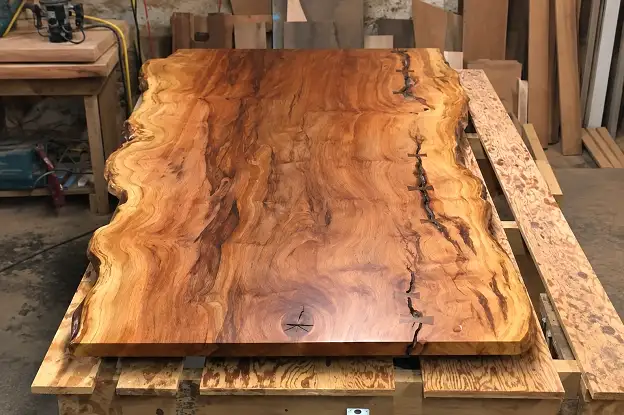
A dining table earns its place in a home through use. It handles rushed breakfasts, long Sunday dinners, holiday meals, homework, coffee, and the occasional spill that nobody wants to discuss. That makes choosing one less about filling an empty spot and more about finding a piece that works with the way the room is actually lived in. Custom wood dining tables offer an advantage here because their design can respond to the space, rather than forcing the space to accommodate a standard size. Oak also offers plenty to work with visually. The grain has depth, the color can vary from one board to another, and natural markings give the surface a character that manufactured furniture often tries to imitate.
1. Start With the Character of the Oak
The slab should be considered before almost anything else. Oak can show tight grain, wider grain patterns, knots, mineral streaks, subtle shifts in color, and other marks created during the tree’s growth. None of these features is necessarily a flaw. In a well-selected slab, they are part of what gives the table its identity. We look at the wood as a whole rather than expecting it to have a perfectly consistent appearance from one end to the other. That variation is often what makes a finished table interesting once it is sitting in a real dining room rather than being viewed as a sample in isolation.
2. Pay Attention to the Live Edge
The natural edge is what gives this style of table much of its appeal, but not every live edge has the same character. One slab may have a quiet, flowing contour, while another may have pronounced curves and changes in width. That difference matters. A highly expressive edge can become the focal point of a room, while a more restrained profile may work better where the furniture and architecture already have strong visual details. We recommend considering how the edge will interact with chairs and how much room people need to move around it. A beautiful contour is not especially useful if it makes everyday seating awkward.
3. Measure the Room, Not Just the Wall
Table dimensions should be based on the entire dining area, not simply the length of the wall where the table will sit. Chairs need room to pull out, people need a clear path around the table, and doors should still open without creating a daily obstacle course. It is worth measuring these clearances before settling on a slab. Length and width also affect how people interact across the table. A table that is too narrow can feel cramped when serving dishes are added, while one that is too wide may make conversation unnecessarily difficult. Good proportions tend to disappear into the experience because everything simply feels comfortable.
4. Think About Everyday Use
A dining table should suit the household using it, not an imaginary version of the household. Consider how many people normally sit down for meals, how often guests come over, and whether the table doubles as a workspace or gathering spot. These details can change the design considerably. Before making a decision, think about the usual number of diners, available floor space, frequency of entertaining, whether children will use the table, and how much room is needed for serving dishes. There is no prize for choosing a table that looks impressive but feels inconvenient every evening.
5. Get the Slab Thickness Right
Thickness has a surprisingly strong effect on the character of an oak dining table. A substantial slab can give a large room a grounded, architectural feel, while a thinner profile may suit a cleaner interior where visual weight needs to be kept under control. The tabletop also needs to relate to the base. A heavy slab paired with delicate legs can look visually unbalanced, while an oversized base can compete with the wood. We consider these elements together because the tabletop should not look as though it were chosen separately from everything underneath it.
6. Choose the Finish With the Room in Mind
A finish changes more than the surface sheen. It can affect how the grain reads, how warm or muted the wood appears, and how the tabletop fits with other materials in the room. Flooring, cabinetry, wall color, natural light, and even the chairs can influence which finish makes sense. The most attractive finish is not always the darkest or most dramatic one. Sometimes a quieter treatment allows the oak to do the work. Since dining tables are used regularly, practical considerations matter too. The surface needs to suit the realities of meals, drinks, cleaning, and normal household wear.
7. Give the Base Some Thought
It is easy to focus on the slab and forget the structure supporting it. That is a mistake. The base affects the table’s visual balance, legroom, stability, and overall style. Trestle bases can create a more traditional presence, while simpler legs may suit a modern interior. Sculptural supports can work when the room calls for something more distinctive. Whatever the design, the base should support the tabletop without fighting for attention. With a particularly expressive live edge, restraint underneath often works surprisingly well.
8. Look Beyond the First Impression
A well-made table should hold up to closer inspection. Look at the smoothness of the surface, the way the edges have been handled, the relationship between the slab and base, and the overall quality of the construction. Natural wood also needs to be approached with some understanding. It is a living material that responds to changes in its environment, so thoughtful construction and finishing matter. For homeowners considering live-edge oak dining tables in Pennsylvania, craftsmanship should carry as much weight as appearance. A photograph can show the grain, but it cannot tell you how solid the table feels when someone leans against it or how carefully the details have been resolved.
Why Customization Makes a Difference
The appeal of custom wood dining tables is not simply that they look different from store-bought furniture. The real benefit is control. The dimensions can suit the room, the slab can be selected for its particular grain and edge, and the finish and base can be considered alongside the rest of the interior. That approach makes sense when the dining table is expected to stay in the home for years. Instead of working backward from what happens to be available, the design starts with the space and the people who will use it.
Conclusion
A strong dining table should feel settled once it is in place. It should leave enough breathing room around the chairs, complement the architecture, and bring out the natural qualities of the wood without looking overly styled. At Fredric Blum Design, we approach handcrafted furniture with that balance in mind, giving the material room to speak while paying attention to the practical details that make a table comfortable to live with. If a dining room calls for something more personal than a standard piece, contact us to discuss the size, wood character, finish, and design that could make the table a natural fit for the space.
FAQs
1. What makes live edge oak dining tables unique?
Each oak slab has its own grain, natural markings, and edge shape. These details give every table a distinct character that cannot be duplicated.
2. How do we choose the right size for a custom dining table?
Consider the room dimensions, seating needs, and walking space around the table. A well-sized table should feel comfortable without making the dining area feel crowded.
3. Are custom wood dining tables suitable for everyday use?
Yes, a properly constructed and finished table can handle regular meals, gatherings, and daily activities. The finish should also match the expected level of use.
4. What should we consider when choosing a table base?
The base should provide stability while complementing the shape and visual weight of the tabletop. Its design can also affect legroom and the overall style of the dining table.
5. How can a live edge oak dining table complement a home’s interior?
The wood’s natural grain and organic edge can add warmth without overpowering the surrounding décor. Choosing the right size, finish, and base helps the table feel connected to the room.